

Looking in the Mirror: What AI Companies See in Their Users
By: Sarah Pita
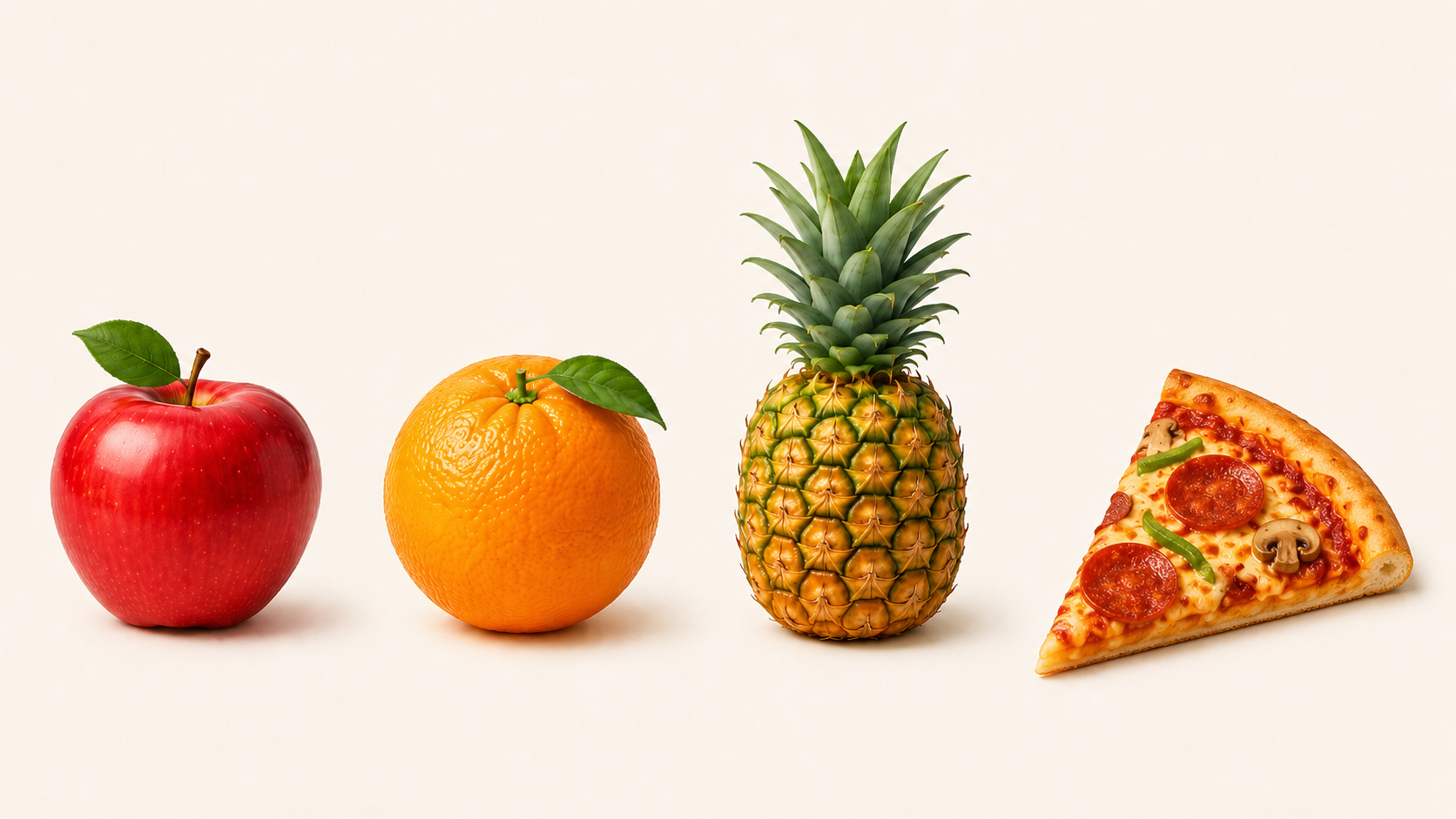
Like comparing apples, oranges, tiny pineapples, and and oddly unappetizing pizza. Image generated using DALL-E.
Sometimes I think about how other people are using AI. Large language models like Claude, ChatGPT, Gemini, and CoPilot have been around for less than four years, and while there seem to be a lot of people out there telling everyone else how to do it right, in the end, when you try out any of these tools, there’s a point at which you’re alone with a screen, looking at a rectangle with a blinking cursor inside.
I’m especially curious about how other people prompt, because while AI outputs to some degree sound the same, it seems to me that individual inputs must be as unique as we are.
Who would know? The major labs, of course. But, as I discovered, they are asking different questions. And they’re each asking slightly different questions than each other.
This week, I took a look at the most recent reports I could find from OpenAI (ChatGPT), Anthropic (Claude), and Microsoft (CoPilot), as well as a June 1 article on Harvard Business Review that studied some 40,000 anonymized, disaggregated social media posts about how people talk about their AI use.
Notably absent is Alphabet (Google). Although they recently took a look at one year of AI search, they have not shared any studies on Gemini use.
Each lab evaluates user activity using different definitions and different metrics, so that a meaningful comparison is almost impossible. Ultimately, it feels like comparing an apple, an orange, a pineapple, and a pizza. Interesting reading, but hard to contrast them directly to one another.
Report Summaries
🍎Anthropic (Claude)
Date: March 24, 2026
Sample Size/method: Approximately one million chats that took place between February 5-12, 2026.
Inquiry: “To understand the economic impacts of AI as early as possible, so that researchers and policymakers have time to prepare.” Builds on several earlier reports; the previous most recent was in November 2025.
Use categories: Directive and feedback loop tasks, which typically fall into the category of automation. Task iteration, learning, and validation, which are types of augmentation.
Most interesting tidbits:
“Writing” is not a specific use category here, despite many people using Claude for writing.
The report flags that use of their tool is most widespread in wealthy countries and among highly educated people.
The report analyzes who is deliberately opting for Opus (their most “intelligent” model series).
If you love maps, check out their dashboard. You can look at Claude usage by US state and by country, and by industry within those countries. In Mongolia, “Develop, debug, and modify websites and web applications” accounts for 8.6% of Claude usage.
Link to report:https://www.anthropic.com/economic-index#us-usage
🍊OpenAI (ChatGPT)
Date: September 15, 2025
Sample Size/method: Approximately 1.5 million privacy-protected conversations.
Inquiry: “How people are using ChatGPT, offering a first-of-its-kind view into how this broadly democratized technology creates economic value through both increased productivity at work and personal benefit.”
Use categories: Asking, doing, and expressing.
Most interesting tidbits:
There are 700 million weekly active ChatGPT users worldwide.
70% of ChatGPT use is personal, and asking for help and advice is the most popular use of ChatGPT.
Overall, 24% of ChatGPT messages are about writing, and at work 42% of all messages are about writing. But 2/3 of those are actually editing, translating, or summarizing a text that came from somewhere else. More people are using ChatGPT as an editor than as a writer! (Note that these numbers come from the full research paper linked in the blog post.)
Link to report:https://openai.com/index/how-people-are-using-chatgpt/
🍍Microsoft (CoPilot)
Date: December 10, 2025
Sample Size/method: Approximately 37.5 million privacy-protected conversations, summarized (no human reviewer ever reads somebody else’s chats). Enterprise subscriptions are excluded.
Inquiry: “To find out how people actually use [CoPilot] out in the world.”
Use categories: Desktop versus mobile, time of day, day of the week.
Most interesting tidbits:
Desktop CoPilot is for work, and mobile is for everything else.
Questions about health are far and away the most popular on mobile.
Conversations with AI on cell phones spiked in the middle of the night.
They documented a surge in chats about love and romance around Valentines Day.
While work dominates during the week, gaming fits into that time slot during the weekend.
This report did not include enterprise subscriptions—people with CoPilot subscriptions through work. Yet during the work week, on desktops, during the day, people are working, reflecting the “permeability of the boundary between professional and personal computing.” Otherwise known as shadow AI use.
Link to report:https://microsoft.ai/news/its-about-time-the-copilot-usage-report-2025/
🍕Harvard Business Review article, June 1, 2026, How People Are Really Using AI in 2026
*Note that I read this article once and took notes, and then hit a paywall when I tried to go back in*
Date: June 1, 2026
Sample Size/method: Survey and analysis of about 50,000 social media posts by people talking about how they use AI.
Inquiry: Study “AI in the Wild”.
Use categories: how people are actually using AI, by their own account.
Most interesting tidbits:
AI use is on the rise, and “personal” is currently the most popular use case.
The authors see a growing trend of people offloading their thinking to AI—writing ever messier drafts and doing the bare minimum of idea generation on their own before coming to AI. They call it “thinkslop” and flag it as a real concern.
I’m curious about this methodology. Given that people who post on social media are a subset of people who use social media, this seems like a specific, self-selected group.
Link to report:https://hbr.org/2026/06/how-people-are-really-using-ai-in-2026
Conclusion: I’m reluctant to draw too many conclusions from this peek at the reporting on AI use as reported mostly by major AI companies. While many have noted that AI is more of a mirror (often a funhouse mirror) of the individual user than it is a genie, these reports show the companies looking in the mirror, and picking out a reflection from the actions of their users. And perhaps the most interesting thing is the frame each of them puts around the mirror. Anthropic is very data-forward, with cool interactive elements, projecting the image of a company that serves savvy, sophisticated users. OpenAI uses the word “democratizing” prominently and leans into a persona of helping and guiding the world. And Microsoft is oddly whimsical and fun, considering CoPilot is the workplace default. All three reflect aspiration and direction as well as reality. It’s an exercise in stopping and looking at a point in time, in a field that is growing dizzyingly fast. Who knows where we’ll be in a year? In a way, that makes the pause all the more important.
About the Author:
Sarah Pita is a fundraising professional with 25+ years of experience and a dynamic speaker who makes AI approachable and immediately useful for nonprofit teams. She leads practical, engaging trainings and workshops on using AI for fundraising and has presented at groups such as Women In Development NYC and at the AFP GPC Leading Philanthropy conference, among others. Sarah is currently Director of Development at the Center for Independence of the Disabled, New York.
Interested in an AI workshop or training? Contact Sarah here.