
From Stress Test to Strategy: 5 Fundraising Lessons Nonprofits Must Carry Into 2026
By: Mike Esposito, CFRE
2025 was not a normal fundraising year. With federal cuts to funding, increased demand for services, and unpredictable political changes, it became a stress test for many nonprofits. That stress exposed structural vulnerabilities, while also reinforcing what truly sustains organizations during uncertainty.
Brooklyn Org put numbers behind what fundraisers were already experiencing firsthand. After surveying 86 New York City based nonprofits last fall, they found that “94% of Brooklyn based nonprofits reported higher demand for services compared with last year, while 60% said they lost federal funding.” The combination of increased need and reduced public dollars forced organizations to make difficult decisions quickly, often with very little margin for error.
Against this backdrop, competition for foundation grants and individual donations intensified. Donor expectations continued to rise, and development teams were asked to do more with fewer resources and less capacity. The lessons that emerged in 2025 were not abstract best practices. They were survival skills.
1. Relationships Matter More Than Ever
Federal funding cuts increased pressure on both institutional and individual giving, reshaping how funding decisions were made across the sector. In 2025, strong relationships stopped being a nice byproduct of good fundraising and became a decisive advantage.
Organizations with deep, trust based relationships with funders and donors were better positioned to navigate funding volatility. When dollars were tighter and competition was fiercer, familiarity and confidence mattered. Relationship strength showed up most clearly when organizations were reapplying for competitive grants, requesting renewed or flexible support, or communicating funding gaps and program shifts to individual donors.
Funders and donors did not just want strong programs. They wanted clarity, trust, and confidence in the organizations they supported. Heading into 2026, the lesson is simple. Transactional fundraising is fragile. Relational fundraising is resilient.
2. Messaging Requires Clarity, Confidence, and Context
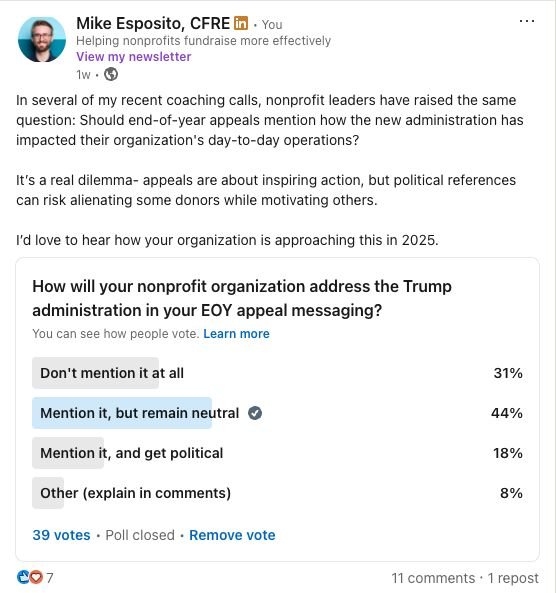
Mike Esposito’s LinkedIn Poll About EOY Appeal Messaging
In September, I asked fundraisers on LinkedIn how their organizations planned to address today’s political climate in end of year appeals. The most common response was straightforward and telling: “Mention it, but remain neutral.”
That instinct makes sense. For many nonprofits, neutrality feels like the safest option, especially when donor bases are broad and political polarization is high. Acknowledging the moment without taking a stance can feel like the least risky path forward.
At the same time, the comments on that poll added important nuance. Several fundraisers noted that messaging decisions should be mission driven, not fear driven. For some organizations, neutrality is not actually neutral. If an organization’s work is directly affected by policy decisions, or fundamentally at odds with an administration’s priorities, stakeholders may expect clarity rather than caution.
For teams weighing how to approach politics in a 2026 campaign, appeal, or donor conversation, three guiding questions can help. First, history. Has your organization historically taken political positions, or do you identify as nonpartisan? Second, audience. Who are your donors and funders, and how might they respond? Third, message. Can urgency and impact be communicated without politics, or is policy context essential to understanding your mission?
There is no one size fits all approach. Donors are not looking for perfection, but they do value consistency and intentionality. In 2026, organizations that communicate clearly, honestly, and in alignment with their values will be better positioned to maintain trust and support.
3. Events Must Deliver Meaning, Not Just Money
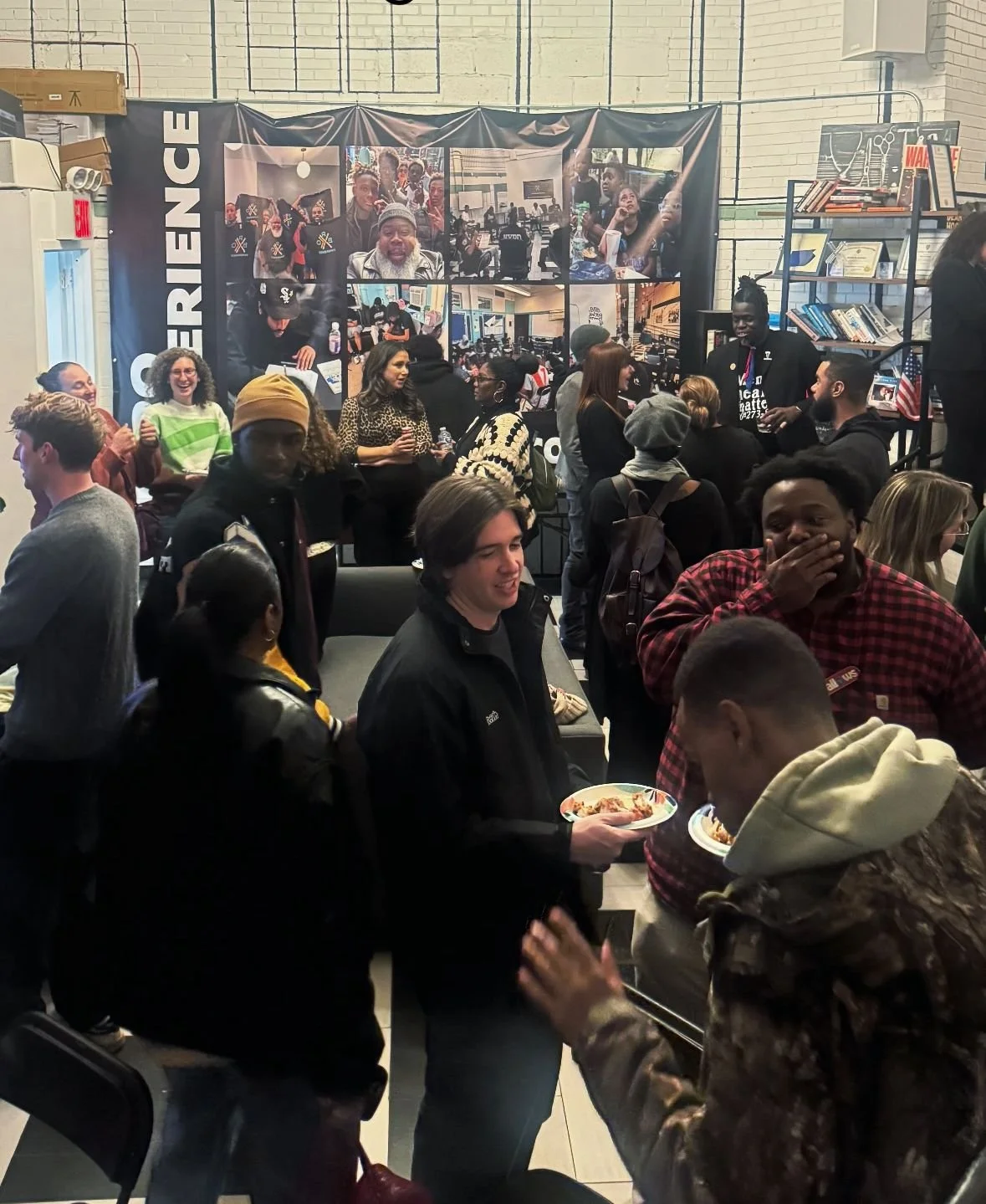
Documentary Screening Event at The B.R.O. Experience Foundation’s Office
In a constrained funding environment, events remain one of the few fundraising tools capable of doing multiple jobs at once. When executed thoughtfully, they can generate unrestricted revenue, increase visibility, foster community connection, and build long term loyalty.
Adam Doyno, Executive Director and Chief Development Officer of the CUNY School of Public Health Foundation, captured this well in a recent AFP NYC piece when he wrote,
“Thoughtfully executed events create moments of collective energy, visibility, and storytelling that institutions desperately need in a constrained funding climate. They deliver unrestricted dollars, attract new supporters, deepen engagement among existing donors, and strengthen institutional reputation. Well designed events can become durable, predictable annual revenue engines that also cultivate community loyalty.”
That framing closely aligns with what donors themselves are signaling. In polls I conducted across LinkedIn and nonprofit groups, one theme surfaced repeatedly. Donors disengage when events feel transactional. Experiences rooted in mission, storytelling, and genuine connection stand out.
As organizations look ahead to 2026, the opportunity is not simply to host events, but to design experiences. Events should be treated as relationship accelerators, not just budget line items. The question is no longer how much money an event raises in a single night, but what kind of connection it creates over time.
4. Stewardship and the Donor Retention Reality Check
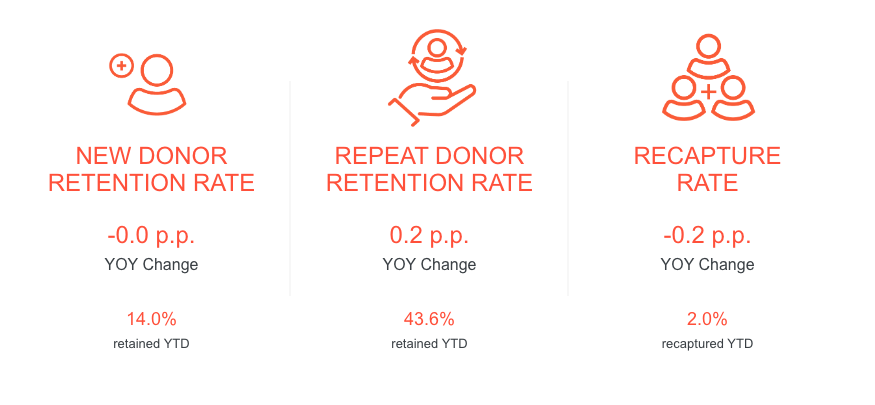
Fundraising Effectiveness Project Data on Donor Retention Rate Data from Q3 2025 (JAN 1, 2025 - SEP 30, 2025)
Data from the Fundraising Effectiveness Project’s September 2025 Quarterly Fundraising Report offers a sobering snapshot of the sector. Overall donor retention was estimated at 31.9 percent. Only 14 percent of new donors from 2024 had been retained year to date. Retention among repeat donors was higher at 43.6 percent, but only slightly so compared to the prior year.
These numbers may be stable, but they remain deeply concerning. Fundraisers feel this tension every day. Donor acquisition costs continue to rise, while retention too often remains under prioritized.
That disconnect surfaced clearly in another poll I ran across LinkedIn and nonprofit groups. When asked why donors paused or stopped giving, the most common response was a lack of acknowledgment. That was followed by too many asks and not enough updates on impact.
The lesson from 2025 is straightforward. Stewardship is not a task to squeeze in after appeals go out. It is a revenue protection strategy. In an uncertain funding environment, organizations that invest in timely, thoughtful stewardship are far more likely to retain and grow their donor base heading into 2026.
5. AI Is Changing Grant Writing, But Not the Role of the Grant Writer
In 2025, many fundraising teams began leaning into AI as a way to stretch capacity and improve efficiency, particularly in grant writing. Used thoughtfully, AI can support drafting, research synthesis, and editing, helping fundraisers move faster without sacrificing quality.
Sarah Pita, who writes the AI content on my website, developed an AI-supported grant writing process that brought in millions of dollars in funding in 2025. In an article from last October, she wrote,
“This method is faster than writing a grant without AI, but I contend that you’re still writing a grant,” You’re just letting the machine handle larger chunks [of information]. Kind of like when we switched from typewriters to word processing.”
That distinction matters. AI can support the work, but it does not replace strategy, judgment, or institutional voice. Understanding funder priorities, aligning proposals with mission, and telling authentic stories rooted in real relationships remain human responsibilities.
The urgency that fuels this kind of innovation is unlikely to go away in 2026. While experimentation for experimentation’s sake can be fun, necessity can bring us to something genuinely useful. Expect more intentional integration of tools that genuinely support fundraising work without compromising quality or trust.
Conclusion
These lessons were forged under pressure, not theory. They emerged as nonprofits navigated funding cuts, rising demand, and evolving donor expectations in real time.
As organizations plan for 2026, the path forward is clearer than it may feel. Invest in relationship depth. Communicate honestly and in alignment with your values. Prioritize stewardship as a core strategy. Design meaningful donor experiences. Use technology with intention and discipline.
Organizations that apply these lessons with clarity and consistency will be better positioned not only to navigate the year ahead, but to build resilience for whatever comes next.

About the Author:
Mike is the Founder and Lead Fundraising Strategist of Mike Esposito Fundraising, a consultancy that helps social service and community focused nonprofits grow individual giving and build sustainable donor revenue. A CFRE-certified strategist and coach, Mike partners with executive directors and fundraising leads to strengthen stewardship, clarify donor strategy, and create systems that make donor engagement consistent and manageable. His work includes individual giving strategy, donor communications, stewardship, portfolio development, and board coaching, helping nonprofits build practical fundraising programs that last.