
Nonprofit Leadership Series: Influencer Marketing
By: Mike Esposito, CFRE
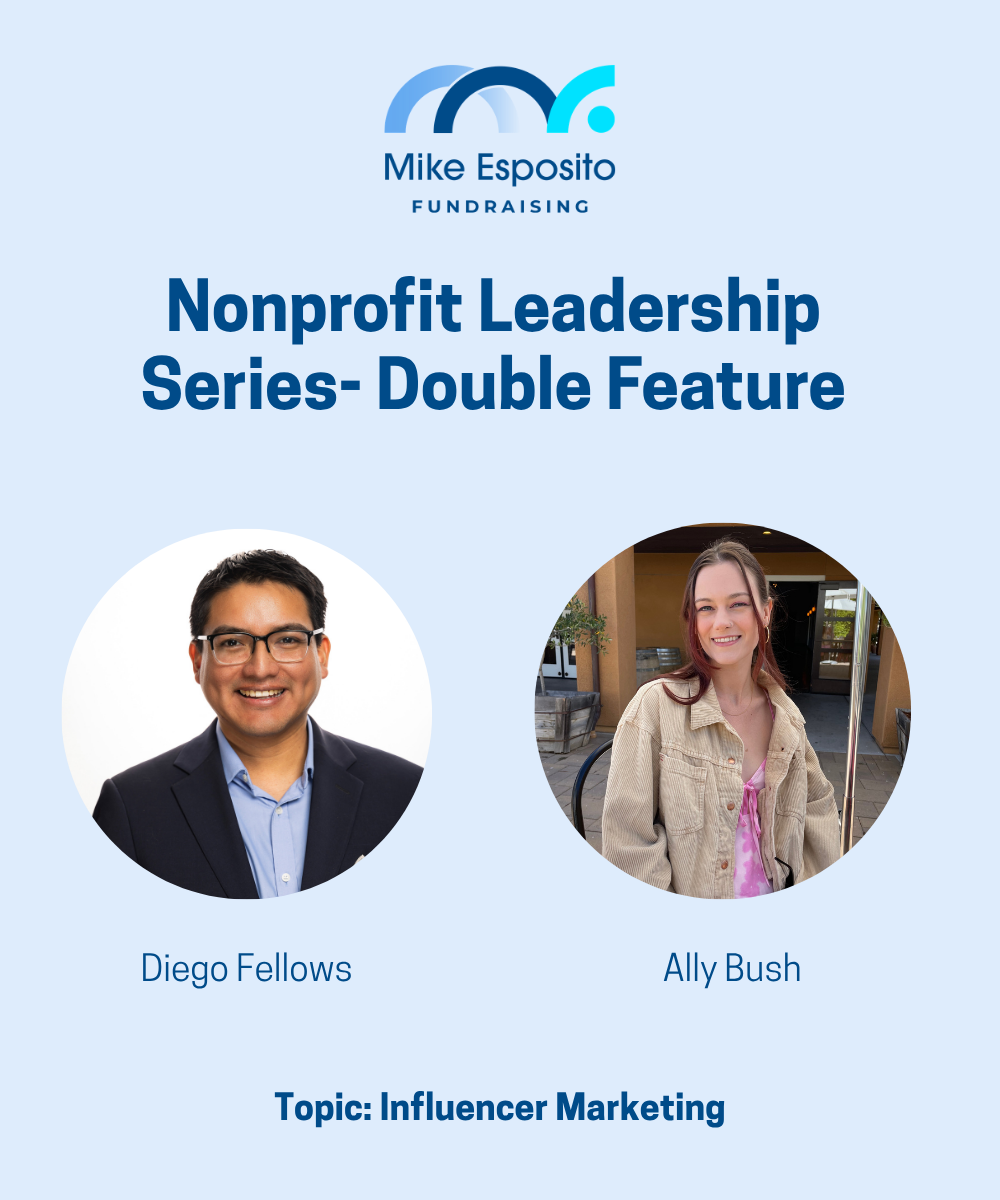
Diego Fellows and Ally Bush share their expertise in nonprofit influencer marketing
Nonprofit fundraising has a reach problem. Younger donors are harder to reach over email, aren’t writing checks, and aren’t showing up to events they heard about through a mailer. So where are they? They're online, and increasingly, they're taking cues from the people they follow. I reconnected with Diego Fellows of UMass Amherst’s Isenberg School of Management at a recent AFP NYC meeting, and he shared that his team has had great success engaging with younger donors through influencer and micro-influencer marketing. I was intrigued, and reached out to Diego directly later to learn more. His hands-on experience thinking through influencer strategy gave shape to much of what follows. He also connected me with his former Reading Partners’ colleague Ally Bush, who worked alongside him there and spent years putting that strategy into practice on the ground. Together, they offer a remarkably practical roadmap for any nonprofit looking to expand its reach.
Why Influencer Marketing Makes Sense for Nonprofits
“We have to think strategically,” Diego says. “We still need to create revenue, build new relationships, and invest in ourselves, so where are we going to find those folks?” His answer: influencer and micro-influencer marketing. Younger donors aren’t reading long emails, and many don’t even use checks. Meeting them where they already are, online, is not just following a trend, it's a necessity.
Ally arrived at the same conclusion during their time together at Reading Partners, when she began noticing a growing community of educators, parents, and book lovers on TikTok and Instagram, a natural fit for the organization’s literacy-focused mission. What started as an experiment grew into a consistent part of their marketing strategy, encompassing volunteer recruitment, AmeriCorps sign-ups, year-end fundraising appeals, and gala attendance. “I thought it’d be a nice way to tap into a new audience,” she says.
Micro-Influencers vs. Macro-Influencers: Where Should Nonprofits Focus?
When most people hear “influencer,” they think of household names with tens to hundreds of millions of followers. But for nonprofits, Diego argues that the sweet spot is often much smaller: someone with around 100,000 followers, operating within a niche community where “you’re going to see real traction.”
The other advantage: micro-influencers tend to post about things they genuinely care about. That authenticity matters. “You want to find people who are already interested in what you’re doing,” Diego says, “because social media at its core is supposed to be an authentic retelling of your story.”
Ally cited a partnership at Reading Partners that captured this perfectly. One poet and author they collaborated with (whose Instagram audience is largely made up of parents and families with young children) was asked to write something about the moment a parent watches their child read independently for the first time. She connected it to Reading Partners in the caption. “The comments were just full of parents saying, ‘I know exactly this moment,’” Ally recalls. “It was a perfect fit.”
How to Find the Right Influencers
Neither Diego nor Ally relied on expensive databases to build their influencer pipeline, and they both suggest most nonprofits don’t need to either.
Start with AI, Diego recommends. A prompt as simple as “Who are the micro-influencers in the literacy space? Give me 10 names” provides a starting point. From there, searching relevant hashtags directly on Instagram or TikTok, such as “BookTok,” “literacy,” or whatever aligns with your mission, surfaces who’s already producing content in your space.
Ally adds one more low-cost tactic: look at what peer organizations are already doing. “I looked up other volunteer-based and literacy organizations to see who they were working with and what kind of content was performing well. It’s a great way to get ideas flowing.” Both also suggest reviewing your own followers for hidden gems. Someone who already follows your nonprofit and has a few thousand engaged followers could be an ideal first partner, since they’re already bought into your mission.
Structuring the Partnership
Once you’ve identified potential partners, outreach is the next step, and Ally is candid that it took some trial and error to get it right.
Always negotiate. Many influencers send a media kit with set rates, but those rates are often designed with corporate budgets in mind. Once an influencer understands the mission, the kids being served and the community impact, the dynamic often shifts. “A lot of them are willing to work with us,” Ally says. “It never hurts to ask if they have a nonprofit discount.”
Send a clear brief. Ally always leads with an overview of the organization, the specific call to action, content ideas, and a timeline. The goal isn’t to script the post, “we always want them to create content in their own voice,” but a few starting ideas help. “The best posts usually start with one of our ideas and then they tweak it to fit their voice perfectly.”
Let the relationship breathe. The most effective influencer partnerships at Reading Partners were built over time. One longtime collaborator began attending multiple galas simply because she believed in the mission, no payment required. The relationship, Ally says, “just feels motivated,” organic enough that posting became its own reward.
Diego frames this in fundraising terms that will resonate with development professionals: “You have to steward them like you would any traditional donor or partner. You have to respect their time, show that you’ve invested in them, and be thoughtful about how you move the needle. If you just cold-ask someone for a brand deal, they’ll probably say no.”
Measuring Success
For Ally, success starts with social media analytics, including views, engagement rates, likes, comments, and shares, but she also watches for downstream effects. A spike in visitors to the volunteer page after an influencer post, or growth in Reading Partners’ own follower count, are signals worth tracking.
Not every post lands, and she’s clear-eyed about that. “Sometimes we see flops. But when it works, it’s really awesome, a ton of engagement, a ton of views, and you can see the impact.”
Common Mistakes to Avoid
Both Diego and Ally flagged a few pitfalls worth calling out for organizations just getting started:
Skipping the research. Vet influencers carefully before reaching out. Are they still posting consistently? Diversifying across platforms? “These folks are ambassadors for your program,” Diego says, “and you want to know they’ll stick around.”
Not negotiating. Nonprofit discounts are often available, but only if you ask.
Mismatched content. The posts that flop, Ally observes, are usually ones that feel out of place in an influencer’s feed. “When the content fits seamlessly into what they already post, that’s when you see the magic happen.”
One More Tool in the Toolbox
Diego also flagged an emerging category worth watching: intermediary companies that manage portfolios of influencers and connect them with brands or organizations looking for ambassadors. While these platforms are still largely corporate-facing, he sees them as a potential future resource for nonprofits as the space matures.
Conclusion
Diego and Ally bring complementary perspectives to this work, Diego from the strategic vantage point of a development professional and Ally from years of hands-on execution on the marketing side, but they arrive at the same conclusion: influencer marketing is no longer just a corporate tool. With the right research, thoughtful outreach, and a commitment to building real relationships, nonprofits of any size can use influencer marketing to tap into audiences they’d never reach through traditional channels.
About the Contributors:
Diego Fellows has been an educational development specialist since 2017. He built his development career holding various fundraising and individual giving roles across Salem Academy Charter School, Reading Partners NYC, and Success Academy Charter Schools before transitioning to higher education. In April 2026, he stepped into his current role as an Associate Director of Development for UMass Amherst’s Isenberg School of Management through the UMass Amherst Foundation. Diego holds a Bachelor’s degree in Political Science from UMass Amherst and a Master of Education in Curriculum and Teaching from Boston University. In his free time, he serves on the Crown Heights Running Club board, trains for marathons and enjoys traveling around the world.
Ally Bush (she/her) has been on Reading Partners' marketing team for six years. She started in 2020 as an AmeriCorps VISTA, then in 2022 was hired on as a marketing associate in a full-time staff role. In 2024, she was promoted as the manager of inbound marketing. Ally is originally from Charleston, South Carolina and has a Bachelor's degree in Creative Writing and Communications from Queens University of Charlotte. She plans to pursue a Master's in English, Linguistics from San Francisco State University beginning in the fall of 2026. In her free time, she likes to read, write, do crossword puzzles, travel, walk around her neighborhood, and spend time with friends.