
Nonprofit Leadership Series: Meena Das
By: Sarah Pita
Meena Das is an internationally recognized expert on AI and data equity. Based in Vancouver, British Columbia, she is the founder of Namaste Data, a consulting firm that helps nonprofits to find and protect the human in their data and use AI positively and beneficially. She is also the author, with Michelle Flores Vryn, of the AI Equity Report, now entering its third year.
I can’t wait to see the Report when it comes out this fall. If it’s not on your radar yet, the AI Equity Report is an incredible resource for anybody who cares about AI in nonprofits—and that should be all of us.
Mike has met Meena in person, but I never have—it’s almost 3,000 miles from Vancouver to Philadelphia, where I live. I met her on LinkedIn, where I’m consistently struck by her ability to hold the human and the tech in focus without forgetting either. If it’s possible to hit it off immediately in the comments section, that’s what we did.
It was a real treat to have this conversation for the Nonprofit Leadership Series and learn more from Meena—how nonprofits can find their own ways with AI, where the work stands with the AI Equity Report for 2026, and also dragons (really!).
Below are some choice excerpts from our conversation.
Sarah: I really enjoyed something you wrote recently about dragons, and why nonprofits need them. Could you tell me some more about that?
Meena: I’ve been watching House of the Dragon lately and so dragons are on my mind. And what’s wrong with House Hightower, but that’s another conversation.
This is what dragons mean to me, in nonprofits. Dragons are about having the fire to say no loudly and clearly when the situation calls for it. In AI adoption this may be saying no to another tool, or to a practice that is poorly thought out and will cause harm.
Dragons are also about having the courage to burn things down. Not at random, but when a tool or practice is no longer serving the mission. I see nonprofits that have a hard time getting rid of anything, and they hold onto practices that are no longer working.
Dragons are about imagination, and perspective. About being able to see things differently (because dragons can fly!) and because with an actual dragon on your team, you can do so much more.
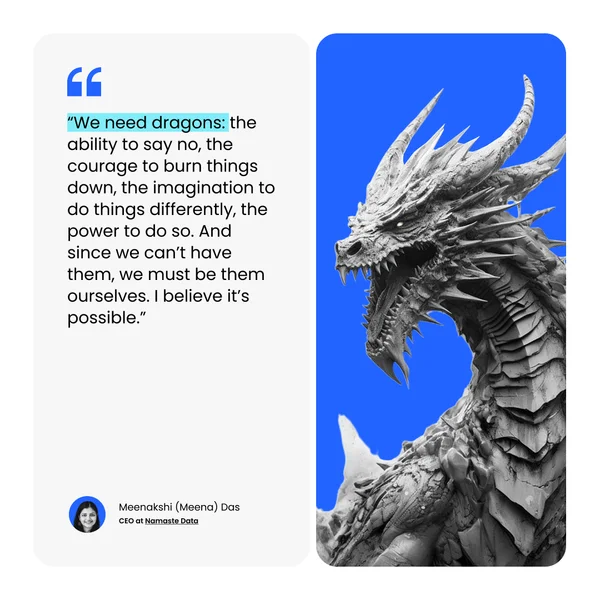
We need dragons: the ability to say no, the courage to burn things down, the imagination to do things differently, the power to do so. And since we can’t have them, we must be them ourselves. I believe it’s possible.
Sarah: I love that. Can you give me an example?
Meena: I was doing an AI training this morning with a cohort I have been working with for the past five years. The group was presenting projects they’ve been working on.
And one nonprofit executive director said, " I don't have anything to screen share at the moment, Meena, but I do have a realization. I started using AI tools on the fundraising side of things and after the session I think I broke my example completely. Now in these four weeks I'm not looking anymore at the AI tools that help me for fundraising."
And so I asked “what are you looking at then?” And she said “I am revisiting the entire definition of philanthropy and generosity in my organization. We are breaking down the metrics of how donors are reached and how many conversations it will take for them to convert into a donor. We are breaking all that to create new definitions like how many times the donor felt curious, how many times the donor felt imaginative and we are using that as a framework to start mapping and using AI. Can we inspire imagination? Can we inspire curiosity?” All those things.
I wasn't the one who led her to that. She did that with her team and her board and it just felt like a very collectively soft, beautiful, amazing moment to cherish and share for the rest of my life that someone is breaking her definition of philanthropy to get to this point.
I think that was a dragon moment for me where she was burning things down that were not supporting and serving her. She's reevaluating the entire definition of philanthropy with her board and leadership.
Sarah: Wow. So breaking things in a very caring way that serves the organization.
I’ve noticed that your work is very much about taking numbers and turning them back into people. We've become a world with so much information being fed into algorithms all the time. As you describe it, you're about taking those numbers and making them mean something again. It’s about stepping out of those boxes. So tell me about the stepping back in part. How do you then walk back into technology from there?
Meena : Well we have to get comfortable zooming in and zooming out. Let's say AI--this pen that I'm holding in my hand [Meena picks up a pen from her desk and holds it up] is AI, and this is me in my fundraising role. What I am learning about this pen, which is AI-- these tech companies around me are the ones who are holding most of the power in how close I can get to this pen or not. So they're the hand, deciding how close I can get to the pen. The problem is that we feel loss of agency. We feel loss of power because we are not zooming in and zooming out enough on our own.
Sarah: So the example from this morning, it was powerful because instead of staying in this AI framework and letting the tech define the discussion, your ED zoomed out, walked away from tech altogether, and came back to it to see how it could help her new vision?
Meena: Exactly. Or, another example would be in the same workshop I gave them a hypothetical exercise where they had to come up with questions to ask their AI vendors. Most questions they came up with were about price. Can there be someone who will be an IT support or tech support person from the company? And what would be the contract terms of this? These are good questions. Surface level questions
I encourage them to go deeper. Hey tech company, tell me do you follow responsible AI? What is your policy around using and doing AI, right? What are the features you are proud of? What are the features that can cause harm? There isn't enough language around that. And so we talked about that part and that's where your stepping out thing happens. We are zooming in closely to look at what is going on and then we are zooming out and then connecting technology to it.
We have to be comfortable stepping in and stepping out with AI. If I am really hyper aware of my context, hyper aware of my strengths, hyper aware of my mission, then I am the one in charge. I am the one with agency to be able to decide how close or far I need to be with AI. So that's where the stepping out happens, being aware of our context.
Sarah: What are you working on right now that you're most excited about?
Meena: Lovely question. The AI Equity Project. I'm very excited about that. I just closed the data collection phase of it. We have about 880 responses. I'm very excited about reading that. I'm keeping my three next weeks blocked to give most of my time to working on this data. The first few days are only sitting with the Excel spreadsheet and looking at row by row and column by column, going very old school.
I will take my laptop, I'll take a chart paper, I'll take a sketch pen and sit in a coffee shop. I have a Vancouver map. I'll pick a neighborhood. I'll go to a new coffee shop in a new neighborhood and I'll start mapping out the data on paper. I go very deep, very nerdy.
I’m excited because this is the third year of the research. I will be able to compare '24 versus '25 versus '26. Year one, my question was where are we as a sector? What's the narrative of our sector when it comes to AI equity? Now have three years of data with hundreds of nonprofits participating in this in this study. Now we can make some reasonable educated understandings from this data. They are not exactly the same organizations in every cohort-- this is a public study. But we can make reasonable deductions about where are we and who are we as a sector, so that when big funders and tech companies and government institutions come and ask our sector who are you and why do you need funding, we have a better narrative to share with data backing it. So I'm very excited about that.
Sarah: If you could give nonprofits one piece of advice about working with AI right now in this moment, what would it be?
Meena: You have to make it collective. We are all right now learning things on our own, trying things on our own, rejecting things on our own. But I want to bring us all on the same page. I want our leadership and our boards to come and say okay let's all talk about the things that we are learning together, the things we are rejecting together, the things we are choosing to accept together. Let's build an institutional position about AI as opposed to our individual judgments.
The more we continue to talk with each other, the more collective we can make it, the better chance we have at designing frameworks and solutions for the long term as opposed to things that are quicker, breakable, more experimentative on our own. Make it collective and make it together.
Sarah: What kind of things do you like to read in the AI field?
Meena: We cannot understand AI just by reading about AI. And this goes for anybody who is kind enough to follow my work. AI is a very single tiny piece of the whole puzzle. We have to read different segments of how the world is coming together in any given moment of time. If we can stretch ourselves to different topics, I think we have a better chance of understanding what is AI and why and how it is happening.
At the end of the day gen AI is really a program that is taking everything that is existing in the world and it's mixing it and making its concoction and making amazing mocktails and cocktails for us from that. If we really want to understand the mocktails and cocktails, we have to understand the individual components going into it.
Sarah: We are almost at time! Anything else you would like to say or that you wish I'd asked and I did not ask?
Meena: The AI Equity Project is coming out in the fall! Once the report comes in I hope everybody finds some happy peaceful minutes with it. Read it! Find your fun with it! This is a work of love and it takes a lot of time to collect this data and read this data and make sense out of it.
Sign up for Meena’s newsletter to get the AI Equity Report when it drops.